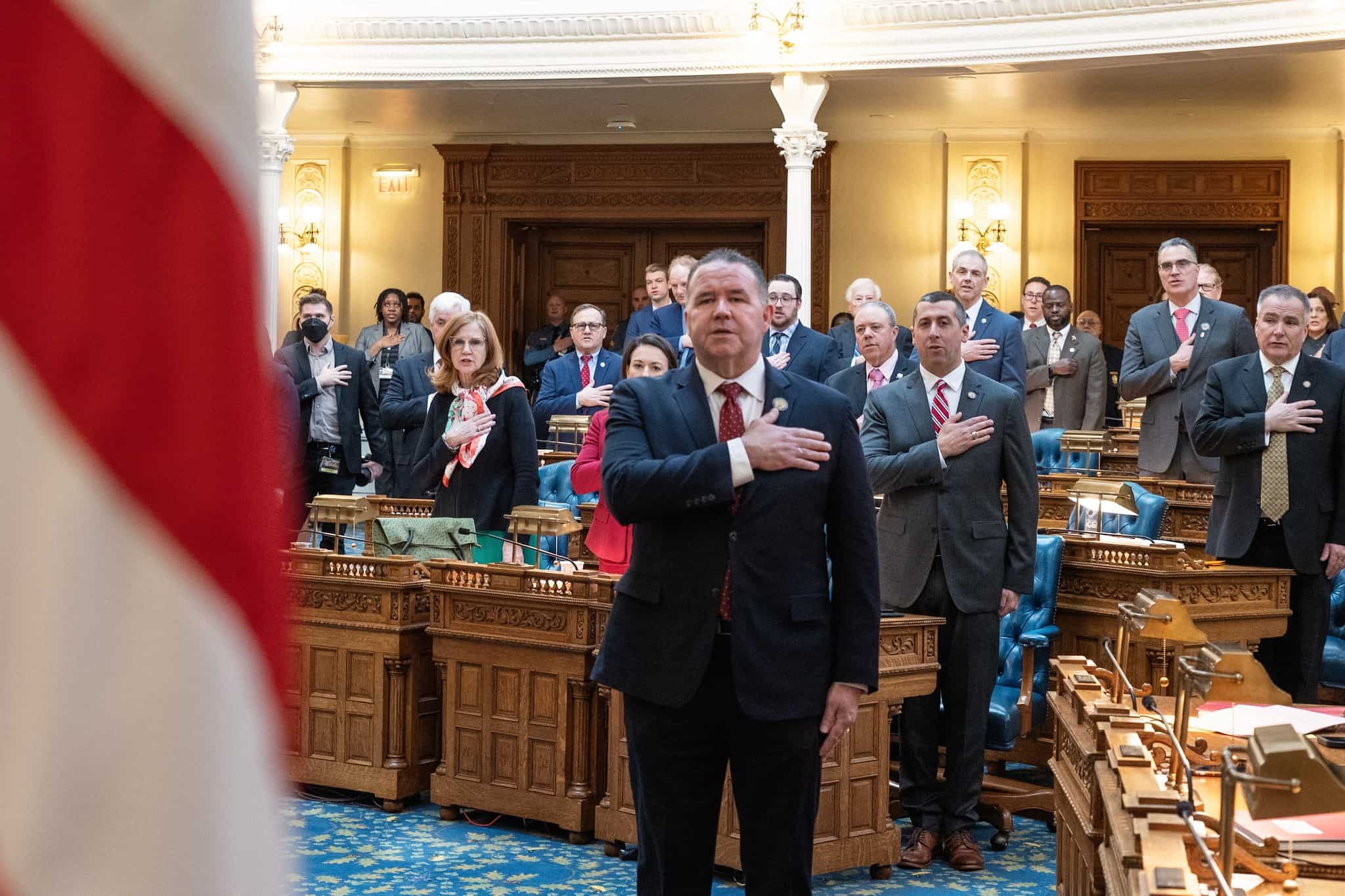
Assemblyman Alex Sauickie introduced a bill package Monday to restore cost-of-living adjustments for retirees in five of the state’s pension systems, including the local police and firemen, State Police, teachers, public sector employees, and judges. The legislation has already garnered bipartisan support and the endorsement of union leaders and advocacy organizations.
“New Jersey’s most selfless public sector retirees have been waiting on relief for more than a decade, because public employees were made scapegoats for the state’s financial problems,” Sauickie (R-Ocean) said. “This bill package is about keeping our promises to those who have kept us safe, educated our children, delivered justice to families and communities, and put the people of New Jersey’s needs above their own.”
The bill package delivers the most relief to those who have been retired the longest, but ensures that retirees who have been receiving a pension for at least 10 years receive monthly cost-of-living adjustments. It is based in part on Pennsylvania’s successful COLA restoration model and benefits members of the Police and Firemen’s Retirement System, State Police Retirement System, Teachers’ Pension and Annuity Fund, Public Employees’ Retirement System, and Judicial Retirement System.
“They held up their end of the deal,” Sauickie said. “It’s time the state did the same.”
COLA benefits were suspended in 2011 as part of a controversial pension reform law. Since then, many retirees have seen their fixed incomes eroded by inflation, forcing some to return to work to make ends meet. Many others, however, have reached an age at which returning to work is no longer an option.
“Living in New Jersey has become more unaffordable over the years and the pensions our public servants have earned have not kept up with rising costs. After decades of dedicated service to this state, many retirees have had to find jobs again,” Sauickie said. “In 2011, the state took away COLA under the premise that it could no longer afford it. Yet, despite stripping police officers, firefighters, teachers and other public employees of their protection against inflation, the state somehow found a way to more than double its annual budget from $28 billion to $61 billion. Clearly, this is no longer a question of affordability, but one of priorities.”
Under the legislation, retirees would receive flat monthly payments rather than percentage-based adjustments. Those who have been retired for 20 or more years would receive a cost-of-living adjustment of $450 per month, retirees of 15 to 20 years would get $300 per month, and retirees of 10 to 15 years would receive $200 per month. All cost-of-living adjustments would increase at a rate of 10% every 10 years. The provisions of the bills would stay in place until an actuarial certification indicates that cost-of-living adjustments may be reinstated for all retirees of the state-administered retirement systems. Funding for the adjustments is contingent upon an annual appropriation in the state budget.
The estimated cost of restoring cost-of-living adjustments across all five pension systems in Sauickie’s bill package is less than $1 billion annually, which is less than restoring cost-of-living adjustments for the Public Employees’ Retirement System alone under previous proposals.
“I’m proud to stand with the state’s retirees and work alongside them on a solution that prioritizes those who have gone without an increase the longest, while recognizing that the ultimate goal is to reinstate cost-of-living adjustments for all retirees and their beneficiaries in a fiscally responsible and sustainable way,” Sauickie said. “I want to thank Assemblywoman Carol Murphy for joining me in a show of bipartisan support.”
Statements of Support:
Wayne Blanchard, President of the State Troopers Fraternal Association: “Whether you were a first responder, putting your life on the line each and every day, a governmental employee ensuring the functions and services of state, county, and local governments were adequate and satisfactory, or a teacher, ensuring that New Jersey’s youth were provided with the education and tools they need to have a successful education and career, each of these employees embarked on a career believing that they would be properly compensated with all wages and benefits, including COLA on their pensions, from the time they answered the call to serve. I can attest personally that our honorable retirees are struggling, as my father, a career firefighter, was forced to retire on a disability pension in 1987, and while currently managing his affairs, his compensation is essentially at poverty level due to the suspension of COLA in 2011. We look forward to working with all of the stakeholders to ensure COLAs return to those in need, while it’s implementation is done responsibly through this legislation.”
New Jersey State Policemen’s Benevolent Association (NJSPBA): “This legislation is a positive step in the right direction to correct the injustice of stripping New Jersey’s retired law enforcement officers of a COLA back in 2011. Since then, the price of everything has gone up while the value of retiree pensions has decreased at the same time. For older retirees, the loss of a COLA was punitive and fiscally damaging. New Jersey now has an opportunity to fix this injustice. We hope the Legislature and the Governor will give serious consideration to making this bill a priority in 2027.”
James E. Ford, President of the New Jersey Fraternal of Police: “We recognize that introducing legislation is only the beginning of the process, but we are grateful to Assemblyman Sauickie for taking meaningful steps toward a solution. This is an issue that should transcend party lines, and we hope his efforts will serve as an opportunity to build bipartisan support around a common goal. Our retirees deserve solutions, not politics, and we look forward to working with legislators on both sides of the aisle to deliver meaningful relief for our retirees, as well as retirees from all public sector unions who have dedicated their careers to serving the people of New Jersey.”
Ken Buck, founder of the NJ PFRS COLA Forum: “I commend Assemblyman Alex Sauickie for his leadership in drafting this bipartisan COLA legislation. I also want to thank Assemblywoman Carol Murphy for serving as co-prime sponsor. Their bill offers a fiscally responsible, fair, and targeted approach, providing immediate and meaningful tiered monthly benefit increases to retirees most in need who have endured years of lost purchasing power, all at a fraction of the cost of fully reinstating COLA for all retirees. Retirees have waited long enough. It is time to turn progress into action and deliver the relief our public servants have earned and deserve.”
Ron DiGiovanni, President of the New Jersey State Retired Police and Firemen’s Association: “I would like to thank Assemblyman Sauickie and Assemblywoman Murphy for supporting our retirees. In this past election cycle, the main point was affordability, yet for the past 16 years our retirees have received no cost-of-living raises. If our legislators truly believe in affordability, then support this bill. It is needed.”
Steve Beatty, NJEA President: “We must begin undoing the harm our retired members have suffered for more than 15 years. Affordability needs to be for everyone and it has become increasingly difficult for New Jersey’s retired educators to afford 2026 prices with a 2011 pension. This bill is a very important step toward restoring fairness and dignity for retired educators and showing current educators that our commitment to our students will be honored when we retire.”
Kitty Sousa, President of the New Jersey Retirees’ Education Association (NJREA): “This bill is an important step forward for NJREA members who have suffered without a COLA for more than 15 years. We kept our promise to the state of New Jersey when we showed up to work every day and helped make our schools the best in the nation. It’s long past time for New Jersey to keep its promise of providing the dignified retirement that we worked for and paid for throughout our careers.”